In 1990 the late Dr. Jonathan Mann assembled other volunteer physicians and founded Doctors of the World (Now Doctors of the World-USA - DOW). Not just a non-profit organization concerned with health issues, DOW is "an international health and human rights organization working where health is diminished or endangered by violations of human rights and civil liberties."
With the help of its local partners around the world, DOW reaches out to the most vulnerable and marginalized populations in the communities in which they serve. They address pressing health issues and build long-term solutions.
The areas of health issues upon which this organization focuses are:
- Tuberculosis and HIV/AIDS
- Orphans and Vulnerable Children
- Women's health
- Survivors of gross human rights abuses
DOW is working on TB and HIV in four regions of the world. In the 14 years since its inception, this organization has developed expertise in strengthening health systems to combat these diseases, which they characterize as "the twin pandemics." And in approaching these diseases, DOW utilizing a rights-based approach explained above.
Women's health is a critical and neglected issue in all of the regions of the world where DOW works. With a commitment to lowering maternal and infant mortality rates, expanding access to health care for women, providing education and services addressing reproductive health, and empowering women to advocate for appropriate health services for themselves and their communities, DOW makes this one of its major focuses.
Regarding Children with Special Needs, DOW's web site states:
"Among the excluded populations served by DOW projects, children remain the most vulnerable and in need of assistance. Doctors of the World-USA is working to restore and protect the basic rights of particularly vulnerable groups of children with special needs: children with disabilities, street children, and children in institutions or separated from their families."
DOW's longest running project (the Human Rights Clinic) because it has always felt the call to addresses the needs of survivors of torture and other gross human rights abuses. In this project, volunteer health care providers aid these survivors of torture within the asylum system by providing clinical examinations and testifying on their behalf. This effort was recently expanded to serve survivors of human trafficking.
Conducting its own projects in over 25 countries, DOW also works within a network of 12 Médecins du Monde/Doctors of the World delegations that operate in over 90 countries.
DOW says that it has a Unique Commitment to Health and Human Rights in that its Mission is stating as supporting:
- The right to the highest attainable standard of physical and mental health…
- The right to equality before the law…
- The right to be free from torture…
Mobilizing a network of health care providers to promote and protect basic human rights and civil liberties around the world, DOW works in areas where health is diminished or endangered because those rights and civil liberties are denied.
In these areas, DOW volunteers and their affiliates provide much needed health care services and train local community members how to continue the health care indefinitely into the future.
In addition to these services DOW advocates for the communities that they serve.
Doctors of the World is a 501(C)(3) nonprofit organization and receives from many Major supporters including: USAID, the Open Society Institute, MAC Aids Foundation, Gruner+Jahr USA, AOL/Time Warner and UNICEF.
The support by these contributors is well founded, as in 2002 DOW volunteer physicians donated over 1,500 hours in health service, over 1,100 of were abroad.
Doctors of the World is autonomous and nonsectarian. It is part of an international network, comprising twelve independent volunteer health services delegations worldwide which strive to provide health care to the world's most vulnerable populations. It is a U.S. affiliate of Médecins du Monde and is a member in good standing of Interaction, the major umbrella group for relief and development organizations in the United States.
In keeping with its theme of "Making Health a Human Right," Doctors of the World participated major conference on "Lessons Learned From Rights Based Approaches to Health" at Emory University in Atlanta, Georgia in June of 2005. There, DOW representatives spoke on lessons learned from DOW's children's health projects and on the health provider's role in documenting evidence of torture.
DOW has projects in India, Iran, Kenya, Kosovo, Mexico, Nepal, Romania, Russia, Sri Lanka, Thailand, the United States and Vietnam, so there is plenty that could be highlighted in this article. But I am going to take just a few lines to discuss DOW's efforts in Kenya.
In Kenya, DOW focuses on HIV/AIDS Prevention, Care, and Treatment and on TB
With approximately 60% of the more than 40 million people globally living residing in sub-Saharan Africa, that places an inordinate number of HIV/AIDS victims living where health systems are weak and access to treatment is minimal.
DOW is working with the Kapenguria District Hospital in the West Pokot District of Kenya to expand and enhance HIV prevention, care, and treatment in the hospital, health centers, and surrounding communities. The West Pokot District is an underserved area of Kenya with a very high rate of HIV infection.
DOW made a Needs Assessment in the area and developed partnerships with local stakeholders and other international institutions working in the area and created a multi-year program plan. After that, they established a field presence at the Kapenguria District Hospital.
A HIV resource database was developed by DOW to share with local partners Kenyan partners in both the public health and NGO sectors.
Priority areas were developed for provider within the context of a whole-site training program at Kapenguria District Hospital. Therein, they focused on an overview of HIV/AIDS issues such as intake, confidentiality, patient diet, preventing and treating opportunistic infections, and counseling.
DOW intends to build the capacity of the district hospital and health centers so as to provide HIV treatment and support services. While doing this, DOW also intends to build the local capacity to provide community-based HIV education for those at risk and provide support to those who are HIV-positive.
There is a lot more to learn about Doctors Of The World, and it can be found at:
http://www.dowusa.org/
Tuesday, August 16, 2005

Monday, August 15, 2005
THE FOUNDATION CENTER: Help Online For Proposal Writing
I receive copies of proposals by email from various organizations asking me to give my opinion on them. And quite often the proposals I receive are not very convincing.
Many non-profit organizations do not have the funds to hire a proposal writer and the regular staffs of many operational organizations often do not have the time to devote to learning how to produce a quality proposal.
While many funding agencies recognize that lack of proposal writing skills does not necessarily mean that the organization sending in the "less than convincing proposal" is not capable of successfully conducting a program, but a proposal must be clear, complete and get its point across.
There is an organization that has a site online that can be helpful to the small non-profit that needs some assistance in proposal writing. The Foundation Center has posted a brief outline of what a proposal should contain. This is not meant to be a compete tutorial on proposal writing, but it should provide the "new comer" to proposal writing with an idea of what an adequate proposal should contain.
The site contains such basic information as stressing the need for gathering the necessary background information for your proposal. Now, this may seem obvious to the veteran proposal writer, but many readers would be surprised at how many proposals go to potential donors with no data to backup what is being asserted.
The Foundation Center's short and simple tutorial takes the reader through a step-by-step process from the Executive Summary to the Conclusion.
As I said before, this is not an exhaustive course, but if you feel that you are "lost at sea" when it comes to preparing a proposal for a funding request, I would recommend your taking a look at the Foundation Center's Short Course on Proposal Writing. It can be found at:
THE FOUNDATION CENTER
CHRISTMAS IN KAMPALA: A Story Worth Telling
The two types of stories that I like to tell the most are those about single individuals with vision, compassion and commitment and those about young people making the world a better place. And this story has both.
The story is about a 21 year old college student named George Srour who went to Kampala, Uganda with the United Nations World Food Programme for an internship in the summer of 2004. While he was in Kampala, he discovered Meeting Point Kampala in the slums of the city - an orphanage that accommodates almost one thousand children, many of whom are "Double Orphans" (those who have lost both their parents to AIDS) and are infected themselves.
While visiting the orphanage, George noticed that the learning center was in terrible condition. It was made of bamboo-and-timber and it had to be rebuilt several times a year because it reportedly would gets eaten away by ants. When he learned that a permanent school building made of durable material could be built for only $8,000, he undertook to raise the money.
Returning to his studies at (the College of William and Mary) in the autumn of 2004, George approached the administration about conducting a campus fund raising, and they agreed.
He called his project "Christmas in Kampala" and went to work raising funds. A web site was posted on the college's online newspaper called the Dog Street Journal. (An online newspaper, which, by the way, George had founded.) The web site asked students to donate $5.00 to symbolically "adopt" an orphan..
In an open letter addressed to the college community, George wrote:
"Each day, (the children) cram themselves into a bamboo-built school house for their lessons. Pointing to a large hole in the wall, the school master mentioned to me the dire need for a well-constructed school house, built of concrete and durable materials. When I inquired about the cost, she said the plans they had drawn up for this would cost approximately $8,000."
His letter went on to say that he wanted to present the orphans "with some of the school essentials they are critically in need of, including uniforms, books, crayons, geometry sets, paper, etc." George wanted to present the orphans with these gifts as a surprise during a visit on Christmas Day 2004.
Christmas in Kampala exceeded its fundraising goals by raising almost five times what was hoped for. George was overwhelmed by the response. William and Mary students, faculty members and staff contributed to the fund, as did members of George's hometown church in Indianapolis, Indiana. George had spent four weeks of his previous summer's internship in at the World Food Programme's Rome office before proceeding on to Kampala, and his former co-workers in Rome raised over $4,000. It is reported that many of those in Rome contributed money that had previously been intended to be used to buy Christmas gifts for traditional gift giving. An additional $10,000 was donated by members of the Key Club International, a high school service program. Incredibly, $500 of the money donated from the Key Club came from members in Jamaica who had suffered devastating hurricanes that year.
The fundraising was so effective that when George and two of his friends made their surprise Christmas Day visit, they not only had the money needed for the building of the new learning center and to provide the students with much needed supplies, they had planned a wonderful Christmas dinner for all of the approximately 1,000 orphans and school faculty at Meeting Point Kampala - a dinner where the students were amazed that they got to eat not only chicken, but meat also.
When George left Kampala after that visit, the students all stood in front of the old weather beaten learning center, with its cracks between the timbers and tin roof and sang a song a song for their new friend. The words of the song were: "Bye-bye embawo," which means "bye-bye timber." That was their way of saying that they knew that their new school building would soon be replacing the old wooden one.
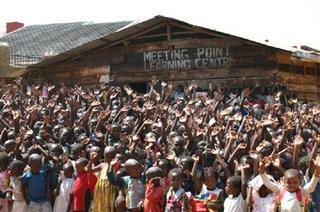
The children of Meeting Point singing "Bye-bye embawo"
Photo Credit - George Srour
George Srour's story has gotten plenty of attention in the U.S. and he was awarded a The Simon Fellowship For Noble Purpose, which comes with a check for $40,000. George says that he will use the Fellowship funds to continue his work helping the needy.
George told one reporter "Originally I thought this would be a one and done sort of project." But after he saw how much people wanted to get involved in helping others he felt that it would be a waste to not make use of that enthusiasm.
George writes that Christmas in Kampala will take place this year and he is in the process of looking for new institutions in Kampala that are in need of assistance that he can help with the $40,000 that he received as a William E. Simon Fellow.
Now - tell me, folks, have you heard many stories better than this one? George Srour does not yet have a formal non-profit organization, and the funds for Christmas in Kampala were raised through the College of William and Mary which is itself a non-profit 501(c)(3) organization. I will post the addresses for this year's web sites when I receive them, but if you would like to look at the web sites for Christmas in Kampala - 2004 the links are below along with a link to the William E. Simon Fellowship announcement of George's award.
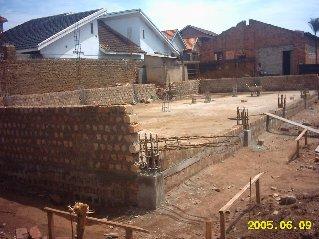
The new Meeting Point Learning Center going up
Oh, and if you are a non-profit organization in Kampala working with orphans, or know of one, post your comments at the end of the article and let George know what you are doing.
Christmas in Kampala 2004
http://www.dogstreetjournal.com/cik/?DSJ=a4dad77a059b7f5c933780f1afd76b92
The Simon Fellowship For Noble Purpose - 2005 Fellows
http://www.isi.org/programs/fellowships/simonwinners05.html
The story is about a 21 year old college student named George Srour who went to Kampala, Uganda with the United Nations World Food Programme for an internship in the summer of 2004. While he was in Kampala, he discovered Meeting Point Kampala in the slums of the city - an orphanage that accommodates almost one thousand children, many of whom are "Double Orphans" (those who have lost both their parents to AIDS) and are infected themselves.
While visiting the orphanage, George noticed that the learning center was in terrible condition. It was made of bamboo-and-timber and it had to be rebuilt several times a year because it reportedly would gets eaten away by ants. When he learned that a permanent school building made of durable material could be built for only $8,000, he undertook to raise the money.
Returning to his studies at (the College of William and Mary) in the autumn of 2004, George approached the administration about conducting a campus fund raising, and they agreed.
He called his project "Christmas in Kampala" and went to work raising funds. A web site was posted on the college's online newspaper called the Dog Street Journal. (An online newspaper, which, by the way, George had founded.) The web site asked students to donate $5.00 to symbolically "adopt" an orphan..
In an open letter addressed to the college community, George wrote:
"Each day, (the children) cram themselves into a bamboo-built school house for their lessons. Pointing to a large hole in the wall, the school master mentioned to me the dire need for a well-constructed school house, built of concrete and durable materials. When I inquired about the cost, she said the plans they had drawn up for this would cost approximately $8,000."
His letter went on to say that he wanted to present the orphans "with some of the school essentials they are critically in need of, including uniforms, books, crayons, geometry sets, paper, etc." George wanted to present the orphans with these gifts as a surprise during a visit on Christmas Day 2004.
Christmas in Kampala exceeded its fundraising goals by raising almost five times what was hoped for. George was overwhelmed by the response. William and Mary students, faculty members and staff contributed to the fund, as did members of George's hometown church in Indianapolis, Indiana. George had spent four weeks of his previous summer's internship in at the World Food Programme's Rome office before proceeding on to Kampala, and his former co-workers in Rome raised over $4,000. It is reported that many of those in Rome contributed money that had previously been intended to be used to buy Christmas gifts for traditional gift giving. An additional $10,000 was donated by members of the Key Club International, a high school service program. Incredibly, $500 of the money donated from the Key Club came from members in Jamaica who had suffered devastating hurricanes that year.
The fundraising was so effective that when George and two of his friends made their surprise Christmas Day visit, they not only had the money needed for the building of the new learning center and to provide the students with much needed supplies, they had planned a wonderful Christmas dinner for all of the approximately 1,000 orphans and school faculty at Meeting Point Kampala - a dinner where the students were amazed that they got to eat not only chicken, but meat also.
When George left Kampala after that visit, the students all stood in front of the old weather beaten learning center, with its cracks between the timbers and tin roof and sang a song a song for their new friend. The words of the song were: "Bye-bye embawo," which means "bye-bye timber." That was their way of saying that they knew that their new school building would soon be replacing the old wooden one.

The children of Meeting Point singing "Bye-bye embawo"
Photo Credit - George Srour
George Srour's story has gotten plenty of attention in the U.S. and he was awarded a The Simon Fellowship For Noble Purpose, which comes with a check for $40,000. George says that he will use the Fellowship funds to continue his work helping the needy.
George told one reporter "Originally I thought this would be a one and done sort of project." But after he saw how much people wanted to get involved in helping others he felt that it would be a waste to not make use of that enthusiasm.
George writes that Christmas in Kampala will take place this year and he is in the process of looking for new institutions in Kampala that are in need of assistance that he can help with the $40,000 that he received as a William E. Simon Fellow.
Now - tell me, folks, have you heard many stories better than this one? George Srour does not yet have a formal non-profit organization, and the funds for Christmas in Kampala were raised through the College of William and Mary which is itself a non-profit 501(c)(3) organization. I will post the addresses for this year's web sites when I receive them, but if you would like to look at the web sites for Christmas in Kampala - 2004 the links are below along with a link to the William E. Simon Fellowship announcement of George's award.

The new Meeting Point Learning Center going up
Oh, and if you are a non-profit organization in Kampala working with orphans, or know of one, post your comments at the end of the article and let George know what you are doing.
Christmas in Kampala 2004
http://www.dogstreetjournal.com/cik/?DSJ=a4dad77a059b7f5c933780f1afd76b92
The Simon Fellowship For Noble Purpose - 2005 Fellows
http://www.isi.org/programs/fellowships/simonwinners05.html
Friday, August 12, 2005
OURMEDIA : Allowing You To Enhance The Effectiveness Of Your Web Presence
Have you ever wished you could speak to your online audience? Or have you ever wanted to show them pictures or a video of your projects. Perhaps you would like for them to see a video of the construction of the school that your organization is building. Or perhaps you would like to give a walking tour of a community you would like to help.
A picture is worth a thousand words and the spoken word can carry much more emotion than text. But quite often the expense of making audio, graphic or video files available to your audience is beyond your organization's budget.
Well, help is here, Ourmedia.org is an online community that allows you to share visual and audio files with the World Wide Web.
Ourmedia is free, but you must also register and obtain a free Internet Archive Account, which will store your files. There are instructions on the Ourmedia web site on how to obtain the Internet Archive Account.
I have not fully explored the Ourmedia site but I did sample some of the audio and video blogs that are there. One of the "Audio Bloggers" on Ourmedia is "Raised Voices." This group has posted quite a few testimonies of individuals on current social issues. One of the testimonials is titled "Raised Voices: HIV/AIDS" and addresses the G8 and HIV/AIDS in Africa.
Ourmedia lets you publish Text, Images, Interactive, Audio, Video and Mixed files. So, drop by Ourmedia, put on your "thinking cap" and think about how Ourmedia might help your Organization get its message out.
You can find Ourmedia at: http://www.ourmedia.org/
SAT: Responding To AIDS With Competence
BEven though the Southern African AIDS Trust (SAT) was established in 1990, it was known as the 'Southern African AIDS Training Programme until 2003. Prior to 2003 it was a project of the Canadian Public Health Association's Canadian International Development Agency (CIDA). But since that time it has held Trust status as an independent regional organization.
SAT is a regional initiative that supports community responses to HIV and AIDS through in-depth partnerships with community groups in southern Africa and wider networking, skills exchange and lesson sharing throughout the region and internationally.
Our overall goal is to build the competence of communities to develop and manage effective, appropriate and sustainable responses to the multiple challenges posed by HIV and AIDS.
It's Regional Secretariat and Zimbabwe Program Office are located in Harare, Zimbabwe; but it also has smaller decentralized offices in Lilongwe in Malawi, Maputo in Mozambique, Dar es Salaam in Tanzania, and Lusaka in Zambia.
Their funding and skills building activities support the capacity development of its partners and their programs in order to create more effective, sustainable and comprehensive community responses to HIV and AIDS.
Even though SAT is no longer a project of CIDAm, it still delivers a large regional project for that organization. But now it has an expanded portfolio of other work funded by a growing number of new resource provider partners.
SAT's vision is to be the leading CBO/NGO support provider in southern Africa. In this way, it believes that it can ensure HIV and AIDS competent communities.
It states that its mission is to work directly and through its partners to increase the HIV and AIDS competence of communities in southern Africa. By increasing community competence, HIV infection can be reduced and the support and care of HIV and AIDS victims will be improved. Additionally competent communities can help to ensure adequate impact mitigation measures and address the underlying factors that make communities and individuals vulnerable. Competent communities can also work more efficiently towards the sustainability of these achievements.
SAT intends to prove and promote the empowering nature and relevance of "south-to-south" skills exchange and lesson sharing. They also intend to work in such as manner as to become known and respected for efficacy and accountability in grants management, integrating monitoring and evaluation into capacity building relationships, and ensuring linkages between financial resources and ongoing technical support. All this while they become a leader in capacity building of CBOs and NGOs.
SAT believes that it's achievements and lessons will offer a model to encourage and inform practice in the broad field of development, not only HIV and AIDS, across southern Africa and globally. And they are fundamentally committed to promoting a co-operative, co-ordinated and non-competitive environment for the response to HIV and AIDS.
Their core values, adapted from the 15th March 2004 draft of the "Code of Good Practice for NGOs responding to HIV/AIDS" focus on
- Valuing human life
- Preventing and alleviating human suffering
- Respecting the dignity of all people
- Respecting diversity and promoting the equality of all people without distinction of any kind, such as race, ethnicity, colour, sex, gender, sexual orientation, HIV status, language, religion, political or other opinion
- Promoting the greater involvement of people living with HIV and AIDS
- Promoting gender equality
- Meeting the needs of children affected by HIV and AIDS, including their need for psychosocial support
- Supporting community values that encourage respect for others and a willingness to work together to find solutions, in the spirit of compassion and mutual support
- Assisting CBOs/NGOs to develop more comprehensive community responses
- Addressing social and economic inequalities and fostering social justice.
SAT is organized into Teams and Units that carry out its mission. In addition to two Management Teams (a 'Strategic' Management team and a 'Business' Management team)
There is a Finance and Administration Team a Country Programmes Team and a Good Practice Team. You can read about the roles and functions of each of the teams at SAT's web site.
The organization works on a national level and on a regional level. On the National Level, it operates programs in Malawi, Mozambique, Tanzania, Zambia and Zimbabwe. On the national level the work has three main components:
Capacity development partnerships with CBOs and NGOs
SAT's School Without Walls and
Publications
On the Regional Level, SAT has:
Regional School Without Walls
Capacity development with regional organizations and
Operations research
All of these programs, both on the national and regional levels have a lot of components and a lot of detail. And as you know that my goal is to write "Brief" articles about the various organizations, I am going to leave it to you, dear reader to go to the Southern African AIDS Trust's web site at: http://www.satregional.org/ to learn more about this effective organization.
Thursday, August 11, 2005
TECHSOUP : Lending A Hand To Non-Profits
Among the links listed by Global Voices is a link to TechSoup.org
TechSoup.org's web site states that it "offers nonprofits a one-stop resource for technology needs by providing free information, resources, and support."
TechSoup also provides instructional articles and informative worksheets for nonprofit staff members who utilize information technologies, as well as technology planning information for executives and other decision makers. Introductory articles and a message board also provide support aimed at those who do not have much experience using technology, but we also provide more advanced information.
In addition to online information and resources, they have a page called TechSoup Stock where they offer a product philanthropy service. At this page, qualified 501(c)(3) nonprofit organizations in the U.S. can access donated and discounted technology products, generously provided by corporate and nonprofit technology partners. And they even have a list of organizations that provide Recycled Computers and other IT Hardware at their TechSoup Stock page (just follow the link).
[Currently, the majority of their donated products are available to U.S. based 501(c)(3) organizations only. But, in time, they expect that to change as they are working with their partners to increase their donation coverage to other international areas.]
This Short Article is just a notice to alert you to TechSoup's presence on the web. There is a lot more you can find out if you Drop by TechSoup.org and see if they can do anything for you, or if you can do anything for them. You can find them on the Web at: http://www.techsoup.org/
Aga Khan Agency for Microfinance Helping The Poor Climb Up The Financial Ladder
This is the third in a series of articles about the Aga Khan Development Network. The first was on the Aga Khan Development Network itself, which is the parent organization. The second article was on the Aga Khan Foundation.
The Aga Khan Agency for Microfinance (AKAM) operates in both rural and urban settings, helping poor people from a various cultures, to expand their incomes, improve the quality of life and become self-reliant.
Partnering with several other agencies, such as the Canadian International Development Agency (CIDA), the Microfinance Investment Support Facility for Afghanistan (MISFA) and Kreditanstalt fur Wiederaufbau (KfW), just to name a few, they it offers a range of microfinance services.
In addition to and external organizations, AKAM also works in tandem with other Aga Khan Development Network agencies "to integrate microfinance and maximize synergies with complementary development activities."
The Agency seeks to help people become self-reliant and eventually gain the skills needed to graduate to the mainstream financial markets in order to reach its underlying objectives, which are to: "alleviate economic and social exclusion, diminish the vulnerability of poor populations and reduce poverty."
It says that the underlying principles of this approach are:
Assessment of Impact: Through careful targeting, monitoring and evaluation, AKAM works to maximise the impact on poor communities.
Sustainability: The aim is to cover inflation-adjusted costs through revenues and to generate a modest surplus that can contribute to expanding the range of services and geographical coverage.
Easy Access and Flexible Solutions: AKAM has devised a variety of institutional approaches and instruments that facilitate access and address different contexts, cultures and local requirements.
Efficiency and Transparency: A major focus of AKAM staff is to enhance the quality of credit through clear, detailed lending procedures, well-documented manuals, properly trained staff and the use of best practices that ensure financial discipline and cost control.
Evolution: As a microfi nance programme grows, it can evolve as required by demand and circumstances, from small microfinance initiatives to microfinance banks.
Business Development Services: Loans are accompanied by training in basic business concepts so borrowers can become financially disciplined, self-reliant entrepreneurs.
Partnerships: AKAM works closely with governments, international agencies and professional organisations such as CGAP.
The Agency acknowledges that microcredit can play a critical role in helping the poor to break their economic and social isolation through a "graduation" process often referred to as the "MICROFINANCE LADDER" that takes time but has proven effective.
The first step of this graduation process usually takes the form of an informal business. Here, the borrower purchases a small quantity of goods on credit to sell nearby within days to generate a small profit.
In the next step, the borrower may engage in manufacturing or processing, providing employment for a few family members.
Afterwards, the borrower may initiate a small business, adding significant value to a commercial item. The borrower may at that point employ several people outside the family. This stage is often described as the threshold from which an entrepreneur steps out of poverty; and it is believed to be the level at which real job creation begins to take place.
There is a parallel between the individual ladder out of poverty and the institutional ladder that assists that individual at the various levels:
Initially, there are "entry-level microfinance programmes", usually at the community level;
Next, a there is a "second tier of microfinance institutions" that may offer a range of services, including savings;
Finally, "microfinance banks, which are regulated entities that lend to micro and small enterprises and offer a range of services comparable to those of local commercial banks. (And sometimes these microfinance banks offer a broader range of services than do the commercial banks.)
AKAM's microfinance initiatives are very diverse and range from village lending cooperatives to self-standing institutions, and its rural development programs initiated several of these programs. The Agency is operating programs in Afghanistan, Burkina Faso, Egypt, India, Kenya, Kyrgyz Republic, Madagascar, Mozambique, Pakistan, Syria and Tajikistan as part of an integrated development strategy within each country.
The development strategy may include business or technical advisory/training extension services and business development programs that work directly with local entrepreneurs. They may also include a regulated microfinance bank that offers a much wider range of services.
Some examples of the programs are listed below.
Burkina Faso
In Burkino Faso, a microfinance initiative was begun in 2004 in the Banfora area, home to 70,000 some people. The Banfora area is home to SN-Sosuco, a sugar plantation and refinery that was acquired under the Burkina Faso privatization program by the Aga Khan Fund for Economic Development. This company employs nearly 4000 permanent and seasonal workers farming its own sugar cane plantations and operates the country's largest sugar refinery.
There, the microfinance program is designed to complement and expand the input credit scheme currently managed by SN-Sosuco. This program targets seasonal workers (and the population at large in the area), who often must find other economic activity during the off-season. Credit is available several uses, including: education, health, housing improvement, economic diversification and group credit and emergency loans. AKAM is considering expanding this program to other regions in the country.
Egypt
In Egypt, partnering with the Social Development Fund, the European Union and KfW, the microfinance program is concentrated in the district of Darb al-Ahmar of Cairo's Historic City. It focuses on the revitalisation of a poor and neglected neighbourhood and damaged by an earthquake in 1992, which is adjacent to one of the Aga Khan Trust for Culture's largest projects, Al Azhar Park.
The Darb al-Ahmar district is home to 250,000 people and the program is meant to support local ownership, stimulate the development of tourism and ensure sustainability of the rehabilitation work. Since the program began a variety of businesses have been either started or further financed; principally within the industries of manufacturing shoes, furniture and handicraft goods. Loans are used to purchase materials for traditional workshops or to create new businesses, such as a dry cleaner and an Internet café. Dilapidated houses are being rehabilitated using housing credits, preserving the historic character of the area while increasing the availability of housing, for which there is a high demand.
As I mentioned earlier, in addition to these programs and others in Kenya, Madagascar, Mozambique and Zanzibar, the Aga Khan Agency for Microfinance also has programs in Afghanistan, India, The Kyrgyz Republic, Pakistan, Syria and Tajikistan.
Microfinance is not an uncomplicated matter; and I am not sure that I did the topic justice, or did justice to Aga Khan Agency for Microfinance. But more information can be found on both subjects at:
http://www.akdn.org/microfinance/index.html#objectives
Wednesday, August 10, 2005
PARTNERS IN HEALTH : Solidarity, not charity alone.
When Partners In Health (PIH) was founded in 1987 by Dr. Paul Farmer, its primary aim was to support the then ongoing activities in Central Haiti, which included a clinic and a training program for community-health workers.
In order to discuss the work of PIH today, you need the help of a world map because they have gone global working in seven countries and on four continents.
Working in Haiti since 1987 with its partner Zanmi Lasante (Zanmi Lasante is Creole for "Partners In Health.,"), PIH has been providing primary health care in the central Haitian village of Cange.
Zanmi Lasante and PIH run a number of programs together. One of those programs is a full-service hospital. They also run rural Haiti's only HIV/TB treatment facilities. A dozen or so schools, a women's health center, and several "cottage industries" are also included in their work.
Currently, Zanmi Lasante and PIH on a daily basis provide over 1,000 patients with free (or on occasion nearly free) quality medical care. This dynamic duo also works together to provide specialized health training to local residents with as pharmacists, birth attendants, and community health workers. They even arrange for advanced training for Haitian physicians and nurses.
Handicapped by the moratorium on development and humanitarian aid to Haiti since 2000, the work provided by Zanmi Lasante and PIH became increasingly more difficult, as over $500 million in approved international loans and grants were blocked by international donors due to a dispute between former President Jean-Bertrand Aristide and the coalition of groups that oppose him. This caused the Ministry of Health of Haiti to cut back on the services it provided, placing a heavier burden on NGOs operating in the country.
In the year 2002 over 190,000 people visited their hospital and medical clinic maintained in Cange. This number was three times the number of patient visits during the previous 12 months. Nevertheless, Zanmi Lasante and PIH had the commitment to expand their base of operations during 2002 and carried health services to additional towns and villages in Haiti's Central Plateau. Screening for malnutrition, tuberculosis, and HIV; vaccinating women and children; and diagnosing and referring sick patients to one of the medical facilities, Zanmi Lasante and PIH's clinical expansion sites in the surrounding area of the Central Plateau saw another 120,000 patient visits during the year 2002.
Despite these difficulties - not to mention the hurricanes - PIH was determined to hold to its mission, which is "to provide a preferential option for the poor in health care."
Within this context the organization has two overarching goals:
"to bring the benefits of modern medical science to those most in need of them and
"to serve as an antidote to despair.
Partners In Health is able to draw on resources from the world's leading medical and academic institutions it brings to that the "lived experience of the world's poorest and sickest communities" based in settings of poverty, by establishing long-term relationships with sister organizations, like Zanmi Lasante.
PIH says that it has a moral mission as well as a medical one. Its moral mission is based on solidarity, and not on charity alone.
Giving their patients in poor communities the same quality of care that they would give to their own families, members of PIH's health professionals, and other team members do whatever they can to provide access to care.
In holding to its mission the organizations maintained its outpatient clinics where patients were treated a variety of infectious and medical diseases. The TB treatment facility at the Hospital and Medical Clinic (Clinique Bon Sauveur) became the primary referral site for all cases of multidrug-resistant tuberculosis in Haiti, while the cases at the hospital included acute disorders from congestive heart failure to malaria.
Volunteer surgeons, nurses, and technicians from various locations in the U.S., such as South Carolina, Miami, and the Brigham and Women's Hospital in Boston, made several surgical trips. And a Cuban volunteer Dr. Pedro Ung directed the completion of a new surgical wing. And while all this was taking place, PIH also helped to reopen a hospital located near the Dominican border and that had been closed for 12 years. The PIH web site reports that: "In a single week, 25 surgical procedures were performed" in that hospital.
But as I stated earlier, Haiti is not the only country that is benefiting from the hard work of PIH. n April 2005 PIH began working in two rural health districts in Rwandawith support from the Clinton HIV/AIDS Initiative and private donors.
There, ased on the model of care developed in HaitiPIH initiated HIV care. In these two sites in Rwanda, PIH will focus on three primary activities.
First they will establish he "four pillars" approachthat worked so effectively in Haiti :
IV care and treatment that is integrated with primary health care,
Maternal and child health,
Tuberculosis control, and
Detection and treatment of sexually transmitted infections.
PIH's second priority is to establish a system of community-based care. The director of Zanmi Lasante's TB/STI/HIV/AIDS program in Haiti (Dr. Fernet Léandre) has been leading south-south" collaboration between PIH's experienced Haitian staff and their new partners and colleagues in Rwanda The focus here is to identify, hire, and train local health workers.
Finally, PIH is working to strengthen the public health infrastructure in the two districts by "recruiting and training administrative and medical staff; rebuilding and equipping clinics; and securing reliable electricity, water, and communications systems."
Besides Haiti and Rwanda, there are seven other countries where PIH has programs, time will not allow me to write about all of them, but I happily present you with the "URL" for Partners In Health, which is:
http://www.pih.org/index.html
Because there is so much more to Partners In Health and Dr. Paul Farmer that I can not even begin to scratch the surface with this short article.
Tuesday, August 09, 2005
THE "Q" FUND: Just One Caring and Committed Person Can Make Things Happen.
The 'Q' Fund is a registered 501(C)(3) U.S. tax-exempt, nonprofit organization dedicated to the support of basic human rights for children in sub-Saharan Africa orphaned by AIDS. But it is also a testament to one woman's determination, caring and commitment.
It's Mission is: "To improve the quality of life for children in sub-Saharan Africa orphaned by AIDS by providing direct assistance with education, food, housing and clean water."
It's Vision is: "To transform world views and attitudes toward the treatment of children orphaned by AIDS and to effect lasting change by empowering those who will champion and carry this vision into the future."
Founded by Chellie Kew, a Palo Alto resident, in 2000 after she was witness to the devastating effects of the AIDS epidemic first-hand.
Kew sought to improve the lives of the AIDS orphans through education and providing clean water and food. The funding for the projects is entirely by outside corporate sponsorship, foundations, and on-going fund raising initiatives. Ms. Kew has also donated profits from her photographic book "African Journal: A Child's Continent," which is a collection of 71 photos of the AIDS orphans she encountered while in Africa.
Kew moved to South Africa in 1997 and visited areas that had been devastated by AIDS, including "villages literally run by children because all of the adults had died from AIDS."
The "Q" Fund provided most of the $30,000 for the construction of a school in Zambia. With the hope that the school will help to create a self-sustaining community, Kew traveled to Zambia to oversee the construction of the project, which was completed in conjunction with funds from the Zambia Ministry of Education. That school (The Chimoza Community School) is now a reality, attracting about 100 children a day in 2004.
In addition to the is a garden that grows food for consumption and commerce. Also, local widows produced school uniforms for the school children that were then purchased by Kew and supplied to the children. The idea, according to Kew was to make it "a collaborative community effort sustained by the school."
But Kew is not resting with her past accomplishments, on December 1st 2005 (World AIDS Day) she is planning to climb to the summit of Mount Kilimanjaro accompanied by five high school girls and five professional women role models in order to bring worldwide attention to the plight of the orphans and to raise additional funds. That project is expected raise $200,000.
Kew embodies the spirit of selflessness that inspires this Blog. According to one source: "She spent $30,000 - maxing out her credit card - to print 5,000 copies of "African Journal." And proceeds from the book go to The Q Fund. As of April that sum approximated $55,000.
In addition to funding the Chimoza Community School the Q Fund also donated $5,000 to Children's Harvest Ministries, an evangelical group whose project in South Africa was providing means for obtaining food, clothing and medicine, school fees and medical care for impoverished children in five African countries. Kew donated the money in gratitude for the help she received from a member of Children's Harvest Ministries who helped her move about the areas where she photographed the children whose pictures are in "African Journal."
Kew started an alternative health care practice as a for-profit business in 1994 but that has been set aside so that she can devote her time to her work on behalf of The "Q" Fund.
The United Nations estimates that by 2010 the number of orphans in sub-Saharan Africa will rise to more than 18 million. And Chellie Kew had resolved to do something about that.
For a really inspirational read, go to The "Q" Fund's web site and read how one inspired, caring and motivated person can make a difference in the lives of those in need.
The "Q" Fund can be found at:
http://www.qfund4aids.org/
Also, links to the sources listed below, and more, can be found at:
http://www.qfund4aids.org/News.html
Sources:
"AIDS expert to address young diplomats" The Paly Voice (3/7/05) http://voice.paly.net/view_story.php?id=2720
"Crusade Of Love" The Guide/ San Jose Mercury News (7/22-28/04)
http://www.qfund4aids.org/News/Mercury_News_Crusade_of_Love.html
"Eye on AIDS orphans: Photographer's book raises money for African kids"
San Francisco Chronicle, Friday Peninsula Section - (4/30/04)
http://www.sfgate.com/cgi-bin/article.cgi?f=/chronicle/archive/2004/04/30/WBGSM6BKPQ1.DTL&type=news
Monday, August 08, 2005
THE PARTNERSHIP FOR HIGHER EDUCATION IN AFRICA
The Partnership for Higher Education in Africa is an initiative of The Carnegie Corporation of New York, The Ford Foundation, the John D. and Catherine T. MacArthur Foundation, and the Rockefeller Foundation.
It was launched in May 2000 to "reaffirm the importance of a vibrant intellectual environment in Africa in nourishing social, political, and economic transformation." The four foundations wanted to "signal their faith in African university leaders, who are rebuilding their institutions so that they can respond to changing societal needs." In order to do this, they support selected African universities and other centers of intellectual inquiry in their efforts to stimulate enlightened, equitable, knowledge-based national development.
The Partnership represents both a belief in the importance and viability of higher education in Africa and a mechanism to provide meaningful assistance to its renaissance.
The Partnership believes that because of its efforts, interest in African universities is greater today than it was when it began in May 2000.
Because of its initiative, the Partnership has influenced funding levels by the foundations and other donors. Additionally, it has influenced the interest and ability of African researchers to carry out higher education policy analysis.
The Partnership has used a case study approach to build knowledge and consensus about the transformations under way in different universities and to inform strategic interventions for policy makers and donors.
Four case studies had been completed. One each at the University of Dar es Salaam and Makerere University, another which takes a system-wide approach to higher education in Mozambique, and one that concentrates on strategic cooperation options and scenarios for tertiary-level institutions in the Eastern Cape of South Africa.
There are also case studies under way in Ghana, which examines that country's public and private universities; and in Nigeria which focuses on institutional studies of four universities: Ahmadu Bello University, Bayero University, the University of Ibadan, and the University of Port Harcourt.
In addition to the above named case studies, there are also three systemic studies taking place. One study is on higher education in Nigeria's national context. Another study is on ICT in Nigeria. The third study is on gender in that nation.
The Partner has combined the selection of local scholars to conduct the studies with a methodology that incorporates active feedback from the institutions involved and other stakeholders. And it has found this approach to be effective. It believes that African ownership of the case studies is important for two reasons - "it provides legitimacy and it demonstrates the capacity of African researchers."
Additionally, the Partnership states that its efforts have enhanced research capacity and have promoted the exchange of ideas and experience across the continent.
As a complement to the individual case studies the Partnership is also supporting analytic work on higher education trends in Africa and on African higher education in the global context.
This research is believe to deliver two fold benefits. It will enhance understanding of innovations and transformation within African higher education systems and institutions and it will guide future funding decisions by Partnership foundations.
In addition to the projects above, the Partnership has funded two meetings in 2001 that examined higher education in a global context and Africa's place within this changing paradigm:
A symposium on "Higher Education in Emerging Economies: Patterns, Policy and Trends." Was held at the Salzburg Seminar for the purpose of reviewing available information about patterns, policies, and trends; to identify current human capital and institutional resources engaged in higher education analysis; and to brainstorm about actions that could help national and international institutions perform more effectively to meet future challenges.
That same year the Yale University International Higher Education Initiative received funding to convened a conference on "International Higher Education and African Development" with the help of funding from the Partnership. This conference provided an opportunity for US and African academics, government representatives, and members of the donor community to explore issues of concern to universities in both developed and developing countries.
The four foundations contributed an aggregate $62.3 million toward higher education development in six focus countries and on an Africa-wide basis during 2000 and 2001. Those six countries are: Ghana, Mozambique, Nigeria, South Africa, Tanzania, and Uganda. The funds were used for joint grantmaking by the Partnership and individual foundation support for selected universities in Partnership countries. The two forms of grantmaking are called: the "Joint Partnership Initiatives" and the "Individual Partnership Initiatives."
The Partner Foundations each made a commitment to provide a minimum of $100 million over five years. These funds will be contributed towards both Joint Partnership Initiatives and Individual Partnership Initiatives. However, the Foundations are ahead of their giving schedule, and the $100 million does not include funds provided to "non-partnership" countries in Africa.
The current priorities for future work of the Partnership include:
Information and Communication Technologies
Emerging Models of Higher Education
Research on Higher Education
Research Ethos
Mandate and Role of African Universities
Core functions of the Partnership that are intended to meet the major challenges to African universities include:
- Providing financial support that:
Concentrates on universities in countries undergoing systemic public policy reform;
Selects universities that are initiating positive change, have a workable strategic plan, and have demonstrated commitment to national capacity building;
Reinforces creative university leadership that can promote a systematic process of internal reflection and institutional change;
Facilitates innovations directed at producing and reconfiguring knowledge for problem-solving, building adaptable skills, and promoting and rewarding intellectual creativity;
Strengthens the ability of individual institutions to play their distinctive role within differentiated national systems of higher education; and encourages inter-institutional collaboration.
- Supporting African and other analysts considering the causes and consequences of change in African universities; examining global trends affecting the evolution of university development in Africa.
- Assisting participating university leaders to identify common challenges across countries through regional networks and to build economies of scale and critical mass in selected fields, especially in the sciences and basic social research.
- Advocating the essential role of strong universities in sustaining economic growth, community coherence, and social justice; stimulating external support; and sharing information with African governments, other funders and the general public, including the individual and institutional grantees that the foundations assist.
- Supporting a forum of leaders of African universities to share each other's experience, concerns, and strategic thinking, and linking this group to the global higher education community.
- Reflecting with participating institutions on foundation grant strategy, assessing what has been achieved and, as part of a communications initiative, sharing what has been learned.
There is a lot going on with the The Partnership for Higher Education in Africa and to get the full story, the web site can be found at:
http://www.foundation-partnership.org/index.php
Sunday, August 07, 2005
USAID seeks African NGO for $1.8 million malaria and tuberculosis project.
The United States Agency for International Development (USAID) is seeking applications for an Assistance Agreement from qualified African regional organizations and institutions for funding a $1.8 million program to expand Best Practices for Malaria and Tuberculosis in eastern and southern Africa. USAID defines African Regional Organizations in the following manner: “African Regional Organizations are ones that are established and with offices based in Africa and run primarily for and by Africans.”
The countries that they define as “Malaria priority countries” are: Angola, Burundi, DR Congo, Eritrea, Ethiopia, Kenya, Madagascar, Malawi, Mozambique, Rwanda, Tanzania, Uganda, Zambia. “Tuberculosis priority countries” are: DR Congo, Ethiopia, Kenya, Malawi, Mozambique, South Africa, Tanzania, Uganda and Zambia.
USAID states that it intends to provide the approximately $1.8 million in total USAID funding to the successful applicant over a 2 year period.
The Request for Applications (RFA) was issued on July 27, 2005 and the Deadline (“Closing Date”) for submission of those applications is September 6, 2005 at 3:00 PM, Nairobi local time.
The RFA is identified as: Request for Applications (RFA) Number 623-A-05-037 and the portal to it may be found at the following web address: http://www.fedgrants.gov/Applicants/AID/OM/KEN/623-A-05-037/Attachments.html
In brief, USAID wants to provide a Grant to an
- African Regional Organization, with
- Proven technical competence in malaria and tuberculosis, that is
- Able to conduct the project in two or more areas in two or more countries in Eastern and Southern African region
The infectious disease components of the project can be done in the same or different locations, with a Population base of 300,000 to 500,000 per area, and the selected project areas should be chosen to show a range of diverse situations: ethnicity, mobile or vulnerable populations, in order to identify the maximum numbers of lessons learned.
Finally, the Organization is to: Disseminate lessons learned at the national and regional level.
The program objective is to strengthen health systems in the region and implement concerning the prevention and control of malaria and tuberculosis.
Malaria Best practices
- Prompt recognition and effective treatment for malaria in children under five;
- Use of long lasting insecticide-treated nets (LLITNs) to prevent infection
- The expansion of malaria in pregnancy activities (MIP) through the use of LLITNs to prevent infection, and Intermittent Preventive Treatment (IPT) in areas of stable malaria transmission.
Tuberculosis Best practices
- Increase case detection of tuberculosis at the community level
- Provide Community-Based, Directly Observed Treatment (CB-DOT) for TB
- Increase access to services for co-infected TB/HIV patients.
Needless to say that the organization must be a non-profit NGO, but according to USAID’s RFA, “all reasonable, allocable, and allowable expenses, both direct and indirect, which are related to the grant program and are in accordance with applicable cost standards … may be paid under the grant.” (The RFA sets out what those cost standards are.)
In trying to decide whether your organization would be a good applicant for this project, keep in mind that the primary objective of the Cooperative Agreement (CA) sought by USAID is to obtain the services of an African Organization with a multi-country regional presence, that has proven technical, managerial, and financial capability to implement and expand malaria and tuberculosis best practices in the ESA (eastern and southern Africa) Region. USAID expects that the organization will work with both the public and private sectors, Non Governmental Organizations (NGOs), Community Based Organizations (CBOs), and other stakeholders to implement malaria and tuberculosis best practices:
The application form is rather detailed, and will discourage anyone who is not serious about applying for this funding. For example, organizations that have not had any involvement with USAID in the past will need to provide it with certified financial reports for the previous 3 years. On the other hand, it is relatively easy to access the RFA and any amendments to it by the internet in order to determine whether you wish to apply. And a word to the wise is that anyone who is serious about this application process should register for updates and amendments to the RFA and also check back periodically RFA’s web site to see if any updates have indeed been posted. Also, the names, addresses, phone numbers and email addresses of the contact persons for the RFAs are found on the RFA’s web site as well.
Questions concerning the project and the application process should be directed to the contact individuals, who are in Nairobi, Kenya. But it would be advisable to carefully read the RFA before asking any questions. And any interested person should take note that the deadline for asking questions is August 16, 2005.
The Request For Applications may be found at:
http://www.fedgrants.gov/Applicants/AID/OM/KEN/623-A-05-037/Attachments.html where you can take a link to the RFA in PDF format or load the RFA with all of the Amendments in a Zip Compression.
And if you would like to look for other possible U.S. federal grants and funded projects you should go to: http://www.fedgrants.gov/
Friday, August 05, 2005
WCE : Computers, Computers, Computers!
Those who have been following this Blog for a while will remember articles about Computer Aid International, Computers For Africa and Computers For Uganda. More and more organizations are attacking the digital divide by making more computers available in the developing world. World Computer Exchange (WCE) is another one of those organizations. And based on the information on their web site, they do their job extremely well.
WCE says that it "is an international educational nonprofit focused on helping the world's poorest youth to bridge the disturbing global divides in information, technology and understanding." They say that they keep donated computers "out of landfills" and give them "new life connecting youth to the Internet in developing countries."
This group has three areas of focus:
1. Capacity Building Assistance
2. Computers
3. Cultural Exchanges
1. Using their own volunteers and strategic allies, WCE helps their partners and universities in developing nations to build: "information and communication technologies (ICT) capacity in technology maintenance, telecentre management, and teacher training, as well as the development, adaptation, and sharing of educational content for local use."
2. In order to connect young people in developing nations to the Internet years sooner than would otherwise be possible, WCE makes available low-cost computers and software for this purpose.
3. In order to foster improved understanding among students in different countries, WCE acts as a broker in establishing sister-school collaborations and online website development connections.
In sum, WCE is "Helping to bridge the global digital divide for our kids and for our future." As their Home Page so accurately states.
Since its beginnings in 2001, WCE has connected 1,388 schools and centers with 616,000 young people to the Internet through 14,339 donated computers - with approved plans to connect another half million youth.
WCE gathers computers from: Baltimore, Boston, Boulder, Burlington VT, Chicago, Colorado Springs, Dallas, Denver, Ft. Lauderdale, Houston, Los Angeles, Miami, Minneapolis, New Haven, Ottawa, Philadelphia, Pittsburgh, Portland, Providence, Richmond, San Francisco, Seattle, Stamford, Stillman OK, Toronto, Vancouver, Vancouver Island, Washington DC, White Plains, Wilmington NC, Winnipeg. We have representatives in Geneva, Helsinki, Stockholm, and Tokyo. They also have, sister-schools, and tech volunteers in many of those locations as well.
In turn, they have 279 partners in 48 countries. Those countries are: Afghanistan, Bangladesh, Bénin, Bolivia, Bosnia, Burundi, Cameroon, Costa Rica, Côte d'Ivoire, Democratic Republic of Congo, Ecuador, El Salvador, Ethiopia, Georgia, Ghana, Guatemala, Guinea, Guyana, Haiti, India, Iraq, Kenya, Liberia, Lithuania, Macedonia, Madagascar, Malawi, Mali, Mexico, Moldova, Morocco, Mozambique, Namibia, Nepal, Nigeria, Pakistan, Philippines, Rwanda, Sénégal, Sierra Leone, South Africa, Sri Lanka, Tanzania, Togo, Uganda, Viet Nam, Zambia, and Zimbabwe. Twenty-eight of these 48 countries are either on the African continent or in the Caribbean.
In addition to what has already been listed, they also provide 103 volunteer online Program Officers for the 48 countries where they have Partners. And they provide online 'help desk' support to schools and centers in the three areas of:
Technology,
Entrepreneurial Telecentre Management, and
Development of Local Content
WCE is the largest non-profit in North America that supplies tested used computers to schools and community organizations in developing countries.
Because of the success of its programs WCE is recognized by and works with UNESCO, UNDP, USAID, World Economic Forum, and Peace Corps Volunteers. They also have a global network of organizations and individuals to help them carry out their programs to which they refer as their "consortium of twenty Strategic Allies"
WCE constantly acknowledges the assistance it receives from individuals and other organizations that make it possible for them to accomplish their goals because they are able to "leverage the resources of businesses, strategic allies, volunteers, and universities to build the capacity of their in-country partners to work with local schools, teachers, and students to capitalize the value of the Internet as a bridge to new resources, opportunities, and understanding."
WCE has also developed the African Universities Initiative to be a part of The Global Digital Divide Initiative of The World Economic Forum. Under this initiative, ten universities in the Democratic Republic of Congo, Ghana, Kenya, Malawi, Moçambique, Nigeria, Sénégal, Togo, Uganda and Zambia; and a consortium of twelve educational development nonprofits are collaborating to build the capacity of the universities to support the expansion of the educational use of the Internet on their campuses. Once this is accomplished, these universities will then each work with 30 local schools to build technology, content development, and telecentre management skills.
WCE also promotes the environmentally appropriate disposal of dead computers and monitors. So, their work is helping the planet on an environmental plane as well.
WCE's in-country partners develop viable plans for how to connect and maintain the computers provided by WCE, and they also raise funds and/or in-kind contributions in order to help to support the program. WCE believes that this 'investment' by the in-country partners "ensures a greater likelihood of success, builds respect and self esteem, and fosters a sense of ownership that effects broader changes necessary to create educational and economic transformation."
WCE has connected over a half million youth to the Internet, and they have approved implementation plans to connect another half million. The copies of the Partner's implementation plans for their projects can be seen at WEC's web site.
If you are interested in computers - either sending them, or receiving them - you really need to visit World Computer Exchange's website at: http://www.worldcomputerexchange.org/ and see how this Class Act is helping to Bridge the Digital Divide.
Thursday, August 04, 2005
IMEC: Five (No So) Easy Pieces
International Medical Equipment Collaborative is a non-profit organization established by IMEC's President, Thomas Keefe in 1995 to distribute medical equipment, supplies and support services to doctors, nurses and clinicians working in clinics and orphanages in impoverished, underserved locations worldwide.
Back in 1995, Tom had twenty years of senior management experience in hospitals, and of course, this gave him intimate knowledge about the field. At that same time, hospitals in the U.S. were "closing, downsizing and eliminating entire services."
Tom believed that "people, given the right vehicle, will step forward to help those in need." Health service facilities in underserved areas had the need, and health service facilities in the U.S. were encouraged to "step forward."
It took some research and contacting people who were familiar with the international issues relating to the vision. But it soon became clear to Tom that there was a vast overseas demand for "retired" medical surplus that could be retrieved and put it back into service around the world.
By providing doctors and nurses with the medical tools to improve the delivery of vital health services, IMEC creates health facilities in the poorest countries around the world.
Since 1995, IMEC has grown to a very large network of individuals with backgrounds in either healthcare or international cooperation. This includes: "doctors, nurses, medical technicians and others who assist in acquisition, testing, reconditioning and training." Sixty countries have received equipment and supplies from IMEC. In addition to their projects in Africa, they serve people in Central and South America, Eastern Europe, Asia, and the former Soviet Republics.
Not only does IMEC answer a great need for medical equipment and supplies in underserved countries, but it also "builds relationships between countries and professionals in the healthcare field internationally."
Being headquartered in Portsmouth, New Hampshire, IMEC could be considered a New England based operation. And the inhabitants of New England are known in the U.S. for their sense of simplicity. This also seems to be the case with way IMEC conducts its business. They keep it effective by keeping it simple.
By "simple" I mean that they have a "Five-Step Process" that takes their projects From Start To Finish.
Working with equipment donors, volunteers, project sponsors (whom they call "shepherds") and caregivers, IMEC carries out its missions as they describe in the following manner:
"STEP 1: Identification
A project is identified through a shepherding group interested in sponsoring a shipment to an impoverished hospital or clinic. (these "shepard groups" are humanitarian organizations, governments, service organization, church group and others willing to support a project over a three - five year period.)
"STEP 2: Assessment
An IMEC assessment team visits the project facility. The team works with doctors and nurses in the hospital to develop an understanding of needs. This provides IMEC with the necessary information to insure that only appropriate medical tools are sent to the receiving hospital or clinic.
"STEP 3: Fulfillment
IMEC matches each project's needs assessment with available medical equipment and Global Service Partners prepare the equipment and supplies for shipment.
"STEP 4: Delivery
All items are packaged and loaded into sea containers for shipment, and delivered directly to the receiving facility.
"STEP 5: Installation
A volunteer project team travels to the in-country facility to be sure all equipment arrives and to assist in installation and maintenaance training."
One example of the work that IMEC has done is the help that it provided to Cooper Memorial Hospital in Monrovia, Liberia. Monrovia had been devastated by the civil war and Cooper Memorial Hospital was left virtually empty after the looting that took place in 1997. The situation was so desperate that patients had to sleep on "beds" made of hay placed on the cement floor. Soon thereafter, IMEC's first shipment of equipment arrived. This shipment contained "beds, exam tables, lab equipment, bassinets, cribs, centrifuges, EKG machines, x-ray equipment, medical supplies, wheelchairs, crutches, and much more."
Since that time, IMEC has shipped a second container to Cooper Memorial Hospital, but the project is still ongoing.
This work is able to be carried out by IMEC because of its dedicated volunteers. They utilize individuals who act as:
Project Coordinators
Furniture Repairpersons
Electronics Repairpersons
Donation Pickup Drivers
Donation Pickup Assistants
Equipment Cleaners
Equipment Packers
Equipment Repairpersons
Linen Repairpersons
Medical Supplies Packers
Office Assistants
Workshop Donations Organizers
IMEC is a lot of people working hard with a simple plan that has five pieces that are not that easy, but certain get results.
I strongly recommend visiting their web site, particularly if you are concerned in any way with providing better health care to the underserved. Perhaps you can help IMAC and perhaps IMAC can help you. You can find them at: http://www.imecamerica.org/index.cfm
Wednesday, August 03, 2005
UOA : Utilizing The Deep Sense Of Kinship
Six years after the first case of AIDS had been diagnosed in the Kagera region of Tanzania, a grassroots effort led to the establishment of UKIMWI Orphans Assistance (UOA) in 1989.
UOA was established to address the crisis created by the existence the orphaned children then numbering 46,000, and on the households of the kinship groups raising those orphans.
UOA's website says that it was "the first grassroots organization in the field of AIDS orphans in Tanzania, and one of the first, if not the first organization in the US to be put in place solely for the AIDS orphans." The organization takes the approach of encouraging kinship members to draw from the cultural strength and kinship resources and network of caring, to link up with local communities to address the concerns of orphans. Quoting that "The deep sense of kinship, with all it implies, has been one of the strongest forces in traditional Africa." UOA believes that given the enormity of the AIDS orphans crisis in Africa, the traditional African resources of the extended family and the community at large musts be fully utilized. This organization says that it was founded by grandparents, kinship and community members, local leaders, educators, business owners, traditional medical practitioners, the clergy and many more individuals.
UOA was born in 1989 when the attendees of a social gathering at Bwanjai village in Kagera region of Tanzania began discussing how to ease the distress of the growing number of orphans in the communities. The people at this gathering decided to pull their resources together and help each other to take care of the children affected by AIDS. UKIMWI is the Swahili word for AIDS and UKIMWI Orphans Assistance was designed to help the vulnerable AIDS orphans.
Since it began, UOA has initiated 90 more projects in Tanzania, Uganda and Kenya helping villages and their kinship groups in raising more than 7,000 orphans and vulnerable children. (The UOA programs in Tanzania are now most often referred to as "UOA-T") Each of the programs is a legally constituted NGOs registered with their respective governments. And UOA is a Washington, D.C. based 501(c)(3) non-profit tax exempt corporation.
UOA works with local village volunteers who identify and define the needs or challenges that face their villages. Planning, decision-making and implementation are carried out on the grassroots level. This provides for the most accurate accounting creates a high trust factor.
The UOA program is built upon the strength of existing kinship institutions in assisting orphans to cope with daily life, growing and developing into socially and economically well-adjusted citizens. Each village program has its volunteer elders who provide leadership in the persons of the chairperson, secretary, treasurers, counselors and various committee members in order to address specific needs. The village leadership holds at least one monthly meeting and general meetings whenever required, with UOA members meeting at least once a week to work on the projects.
UOA also states at its website that: "Although external resources have been highly leveraged, the program has been sustainable in confirmation of UOA's tenet: A locally initiated sustainable program of assistance run by concerned capable extended family / community leaders and householders is more meaningful, effective and sustainable."
UOA's Mission is to provide "the necessities of life and basic services to enable (AIDS) orphans and vulnerable children in Africa to grow and develop into mature, responsible and self-dependent members of their communities and nations."
" It is also the mission of UOA to build, through socio-economic development, the capacity of the kinship groups/extended family members and communities in order to serve the needs of the children under their care."
UOA is committed to
1) alleviate hunger, provide shelter, clothing, and other necessities of life;
2) build each orphaned child's confidence and ability to rely upon themselves economically and socially;
3) assure orphans have access to necessary resources and micro-capital to succeed in UOA facilitated self-reliance programs. UOA-facilitated host families are given the choice of a Banana/Coffee Plantation or Kibanja land-based orphans support project, which are outlined on their web site.
In Tanzania, UOA has served orphans located in six wards in the three districts of Kagera region by helping the assisted villages to create about 65% of resources needed to raise the orphans. Household needs assessments were conducted in 1990 and 1991 and revealed two types of needs: (1) short term: provision of basic needs such as schooling, food, clothing and bedding, shelter and health care which required immediate attention, and (2) long-term needs of food and economic security including food production, income generation, and rehabilitation of orphans' houses. The long-term needs, especially food production and the economy were given priority. Consequently UOA-T undertook Food Production and Economic Development: The Banana / Coffee Farm-Based Development Program.
In addition to the food production program UOA provides Complementary Support Services to the Kibanja that include:
- Education
- Health and Well-being
- Skills Development and Vocational Training
- Maruku Youth Fishing Project
- Farm Implements: UOA-T provides various implements to support farming households including hauling truck, grain mill, thrashing knives, etc. to support the farmers
- HIV/AIDS Education & Prevention: a long-term effort to reduce the number of orphans.
With regard to this last matter, UOA says that its "activities reflect a community commitment to the sustainable reduction of the spread of HIV/AIDS through preventive health education, risk avoidance, parental/community involvement in education and training, in proper care of people affected and infected with HIV/AIDS. UOA-T activities include community education and sensitization about HIV/AIDS, peer education and information sharing, counseling, etc. Pending on the availability of funding, UOA-T is planning an unprecedented, full fledged, culturally appropriate community education campaign in Kagera Region and beyond, focusing on the young people between the ages of 14 - 25."
What I have given you is just the Very Briefest outline of what UOA is doing. You cannot get the full sense of what great work this group is undertaking unless you visit their web site at: http://ukimwiorphans.com/ . They have some very good ideas and seem to have a solid plan for achieving their goals.
Tuesday, August 02, 2005
AFFORD: Supporting the Supporters
Because the "Bazaar" usually posts articles about organizations that have ongoing projects in Africa, or among the Diaspora, when I first saw the AFFORD web site I began to search to determine what projects it was conducting in Africa. At first I was disappointed because I could not find that it had any operations in Africa. But then I began to settle down and really read the content of AFFORD's web site. And that's when I came to understand what a valuable resource AFFORD is.
These guys tell you right from the beginning that they are: "Supporting African diaspora's contribution to Africa's development." And by this, the mean that they do not conduct development or relief work in Africa. But they provide a lot of assistance to those organizations that do.
Founded as the "African Foundation for Development" (AFFORD) by a group of Africans in the UK in 1994 as a registered charity, the organization was designed to respond to the concerns, that while large numbers of Africans in the UK had organized to contribute to Africa's development, these groups "were effectively marginalized from mainstream development activity directed towards Africa." AFFORD was also grounded in the knowledge that African could provide each other with the knowledge to address the problems facing the Continent, and should in fact do so.
From the beginning the mission of AFFORD, has been to enhance and expand the capacity of Africans in the diaspora to contribute to Africa's development. And it plans to do this through four strategic goals:
- To shift the balance of power to Africa
- To influence the African development agenda
- To strengthen AFFORD's legitimacy and effectiveness
- To build a strong and sustainable AFFORD
AFFORD's first project was to conduct a Survey of African Organizations in London in order to inventory the existing skills and efforts already at play on behalf of Africa. Strengths and weakness had to be identified and work to develop ways to utilize the strengths and shore up the weaknesses.
This would also provide a basis for learning from the work that African organizations were already doing and to help make the work of the existing organizations more effective.
The messages that AFFORD heard were that:
The organizations wanted to end their isolation and fragmentation
They wanted to keep doing what they were doingm but they wanted to do it better
They wanted to involve more young people involved
They wanted to communicate with mainstream organizations in order to work together
They wanted to effectively connect to work for Africa's development
AFFORD has several Core Values, and I am not going to list them all here, but the first of those values is:
"We have pride & confidence in Africa & Africans & believe in the inalienable right of Africans in Africa to shape their own destiny."
And that is a very good place to begin. To see what other Core Values comprise the "Driving Spirit of AFFORD's members and staff," you can go to the following page on their site: http://www.afford-uk.org/about/values/
AFFORD says that their stakeholders are the African diaspora as an important stakeholder in Africa's development. Other key stakeholders are mainland African civil society organizations, governments, businesses, funders, bi-lateral and multi-lateral agencies, and mainstream NGOs.
Their work is organized into a range of services that are mainly organized into three areas:
Sharing information
Facilitating networks
Building capacity
Sign-posting career opportunities
Influencing development policy
In order to provide valuable resources to the organizations it serves AFFORD has a "Database of African organizations." This database is of UK based African civil society organizations engaged in development activities both in the UK and in Africa. They are also in the process of adding data so as to include agencies and organizations (such as donors, organizations located in Africa and Pan-African institutions) whose work is relevant to UK-based African organizations.
This Database is seen as an important resource to assist increased partnerships and linkages between African organizations in the Diaspora and civil society organizations in Africa and they encourage interested African organizations to add their information to increase the size of the Database.
AFFORD believes very strongly that its ability to achieve its mission is dependent upon engaging with and supporting the work of young Africans as well as UK-based African civil society organizations (UKBACSOs).
These young Africans are individuals engaged in academics, media workers, art, business and other areas and are regarded by AFFORD as key agents within UK African civil society.
UKBACSOs comprise a wide range of organizations and roughly fall under one the following categories:
African led NGOs
Alumni associations
Ethnic associations
Faith organizations
Hometown associations
National/Regional associations
Political associations
Professional associations
Welfare associations
Women's associations
Investment group/business
Welfare/refugee groups
Supplementary schools
Virtual organizations
Research/think tank
Arts/cultural groups
Development education centers
There are a lot more things that AFFORD is doing, but my job is to make you aware of their good work and then direct you to where you can learn more. However, I cannot conclude this article with out mentioning the fact that AFFORD has a program to help organizations improve their fundraising and resource mobilization skills.
This is a joint undertaking with the organization "Fahamu" to present the course: "Fundraising & resource mobilization among the African Diaspora in the UK." AFFORD says that "Fahamu has played a pioneering role in using the new information and communications technologies to support capacity building and networking between civil society and human rights organizations." The course is a distance learning course for individuals & organizations that uses CD-ROMs, email, and workshops. The course is targeted specifically towards Africans in the Diaspora and their organizations and is anchored in AFFORD's clear understanding of the unique challenges such organizations face. The course participants learn how to:
Raise much needed funds for their causes
Build a constituency in support their cause
Improve their chances of getting support from major funders, trusts and foundations
Manage relationships with their funding sources much more effectively
Prioritize their time and energy, so they are doing sufficient fundraising to get the funds they need for their work.
These are skills that all such organizations need to have. If you would like to find out more or to register interest in this course, you need to go to AFFORD's web site.
Well Dear Reader, I wanted to tell you about AFFORD's "African Diaspora and Development Resource Center (ADDARC)" but I am out of time. But you are not out of luck, because you can visit AFFORD at: http://www.afford-uk.org/
And read all about it. And there is a lot more you can read about there - as well as find links to Fahamu's and many other organizations that are about improving the quality of life of Africans on the Continent and in the Diaspora.
[Note - I should not depart without apologizing to my dear friends in the UK for turning your "s"s in "ogranisation" into "z"s and reversing the "re"s in your "centres" in my incorrigible "Yank" fashion.]
Monday, August 01, 2005
STUDENTS IN FREE ENTERPRISES : Worthy Of The Commitment
n 1975, SIFE was founded in the United States as a global, not-for-profit education organization to help improve the quality of life and standard of living around the world. The aim was to do this by teaching the principles and values of free market economics to students around the globe. SIFE organizes, trains and motivates these university students who, operating in teams, teach others an understanding of the principles and values of free enterprise.
Defining free enterprise in terms of free market economics, entrepreneurship, personal and financial success skills and business ethics, SIFE organizes teams of university students who are guided by faculty advisors. These students are called Free Enterprise Fellows.
SIFE says that its principle is simple. "Through teaching others, SIFE students gain a practical understanding of how market economies work. They gain the opportunity to make a lasting difference in their communities and to develop leadership, teamwork and communication skills."
By conducting educational outreach projects throughout the academic year, these teams of Fellows ultimately engage in a system of global competitions where they present oral, audio visual and written summaries of their work to be judged by leaders in business.
SIFE is organized into five international regions: Africa, Asia, Central Asia, Europe and The Americas. Competing nationally and finally globally in the SIFE World Cup these students are given the opportunity to reach their full potential by helping others reach theirs. Life skills such as teamwork, leadership, communication and project management are learned in a unique way that cannot be gained in the classroom alone. And they gain these skills while making a positive difference in the lives of others.
According to the SIFE Africa web site, SIFE students, among other things, teach youngsters the importance of getting a sound education, developing the right attitude and acquiring the skills necessary for success. They teach small business owners and entrepreneurs how become more successful by helping them to solve real-life problems. They improve communities by teaching citizens (employers, workers and consumers) a better understanding of how free markets work in a global economy.
SIFE currently has national programs in eleven African nations. Those nations being: Botswana, Egypt, Ghana, Kenya, Lesotho, Morocco, Nigeria, Senegal, South Africa, Swaziland and Zimbabwe. National Competitions are held in each of these countries annually.
Working with students in 1,800 universities in 46 countries globally, SIFE has sponsored over 5,000 community-based business development and training/educational projects. All of these projects was designed and implemented by university students under the supervision of a faculty advisor and professional managers from local businesses or financial institutions.
When I began doing research for this article, I thought that it would be nice to list all of the universities in Africa that participate in SIFE. Then I learned that approximately 130 universities in the eleven African countries I listed above. So the best I can do for you, dear reader, is to give you the link to the web page where the full list of these universities is presented.
http://www.sifeafrica.org/enrolled_schools.asp?MENU=Student
The SIFE projects and comptetitions could not take place without the support of the generous corporations; 50 of which are Africa-based companies and financial institutions.
During the academic year, the SIFE teams develop and implement micro-business, or education and training projects that promote and/or teach (1) free market economics (2) entrepreneurship (3) business ethics and (4) personal and financial success skills.
According to the web site guidelines are provided to help suggest projects. These guidelines encourage the students to conduct projects that:
"- promote open and competitive economies;
- create micro-businesses sustained by profits;
- increase access to the economy;
- improve economic or financial delivery services to the underserved;
- teach employment skills and basic market economics, especially to women, girls, and the poor;
- link skill development and know-how with employment, income generation, and poverty reduction;
- teach or advocate transparency and ethics in business and public life;
- establish private-public partnerships to stimulate economic development, opportunity, and growth, and so on.
Each project is also required to have a media outreach and public relations component to promote the project's training, themes, and accomplishments--as well as to promote the notion of teamwork, volunteerism, and good corporate citizenship. Long-term impact is also urged."
It is not difficult to imagine the impact that SIFE is having in the African communities in which its projects are being conducted. The efforts of the SIFE students have a profound effect on at-risk youth, students of all ages and small and large businesses, turning these university students into heroes in their own communities.
SIFE believes that its programs can positively impact GDP, unemployment, and many other aspects of the economy, contributing to the success of the New Economic Partnership for Africa's Development (NEPAD).
The site also states that: "(w)hile the SIFE World Headquarters provides leadership training, career opportunities and world-class competitions, all at no fee to thousands of students each year, SIFE continues to need business and community partners interested in giving of their time, talent and treasure to further SIFE around the African continent and the globe. It's an effort worthy of commitment.
The list of SIFE Africa projects (like the list of SIFE Africa universities) is too long to list here, but I would like to give just a few examples of the types of things that they are doing.
The students at the University of Uyo SIFE in Nigeria launched the "Operation Kill Unemployment" program "organized for graduates, students on college break, and married women. Unemployment among these groups is very high and so to combat this problem, UniUyo SIFE taught program participants how to start, finance and manage micro enterprises such as bakeries, fruit juice extraction, and poultry. The 117 participants learned skills required for successful entrepreneurship: identification of a need, production, financial management, ethics and business social responsibility."
"United States International University-Africa SIFE in Kenya conducted several entrepreneurship training sessions for small business owners, entrepreneurs, and the youth of Kibera (one of Africa's largest slum dwellings). USIUA SIFE students saw the need to train these people in the following areas: entrepreneurship opportunities in various industries, requirement of entry into self employment, business performance, how to meet government requirements, diversification, risk management, business ethics, and financial independence. After the training sessions, an analysis was conducted and 70% of the trainees were able to make positive change to their businesses."
"University of the Free State SIFE in South Africa worked with orphaned street children from the Heidedal center. UFS students introduced the Cashflow for Kids board game, designed to teach about money, investing and accounting. Instead of right or wrong answers, the game encourages problem-solving and decision-making skills. Cashflow for Kids teaches children about personal entrepreneurial communications and financial management skills needed to successfully compete in the business world."
I'm sure you get the idea, but if you would like to see lots more projects go to:
http://www.sifeafrica.org/africa_projects.asp and you will see a much more complete list of the projects.
I know that the article is getting just a bit long, but I would like to say that not only are the SIFE teams in African universities working on problems in Africa but some of the other universities are doing so as well. For example, the SIFE team at Nottingham University in England conducted a project entitled the "Tanzania Book Project" which focused on sending educational material and school equipment from England to Tanzanian schools in the summer of 2005. These educational materials included
School Books
School Supplies (pens, paper, chalk, etc...)
Sports Equipment (sports kits, footballs, etc...) and
Computers
I could go on and on about SIFE and SIFE Africa, but I am going to leave it to you to go to their web sites and learn more, because they are worth the commitment.
SIFE
http://www.sife.org/
SIFE Africa.
http://www.sifeafrica.org/Default.asp
Subscribe to:
Posts (Atom)